Closet Capacity Calculator
Free closet capacity calculator: enter your closet's width, depth and rod length to see how many hanging and folded clothes it holds, plus a layout plan.
Most closets are planned by eye. You buy a rail, a stack of boxes and a shoe rack, then discover the coats do not clear the back wall. This calculator does the sums first, so you know what the space can hold before you organise it, or buy anything for it.
What the calculator works out
Three numbers go in: the width of the closet, its depth, and the length of the hanging rod. From those it gives you a hanging count, a folded count, and a short note on how to lay the closet out.
The sums behind it are simple:
Hanging = rod length ÷ inches per item
Folded = (shelf width ÷ stack width) × shelves × rows
Rows is one, or two when the closet is deep enough for a second row behind the first. If you tick the shoe row, it allows about 8 inches of floor per pair.
Everything updates as you type, so you can try the closet as it is, then try it with a second rod or one more shelf and see what changes. Nothing is saved or sent anywhere.
How to measure a closet
You need a tape measure and two minutes. Write the numbers in your phone as you go.
- Width. Wall to wall inside the closet, at rod height. In a reach-in with return walls either side of the door, the inside width is wider than the opening.
- Depth. From the back wall to the inside face of the door or frame. A hanger needs roughly 21 inches to hang straight; 24 inches is the usual build depth and gives clothes some air.
- Rod length. Measure the rod itself, not the wall. Brackets and the end of a sliding-door track often leave a few inches you cannot use.
- Shelves. Count only the shelves you would put clothes on. A top shelf full of suitcases does not hold jumpers.
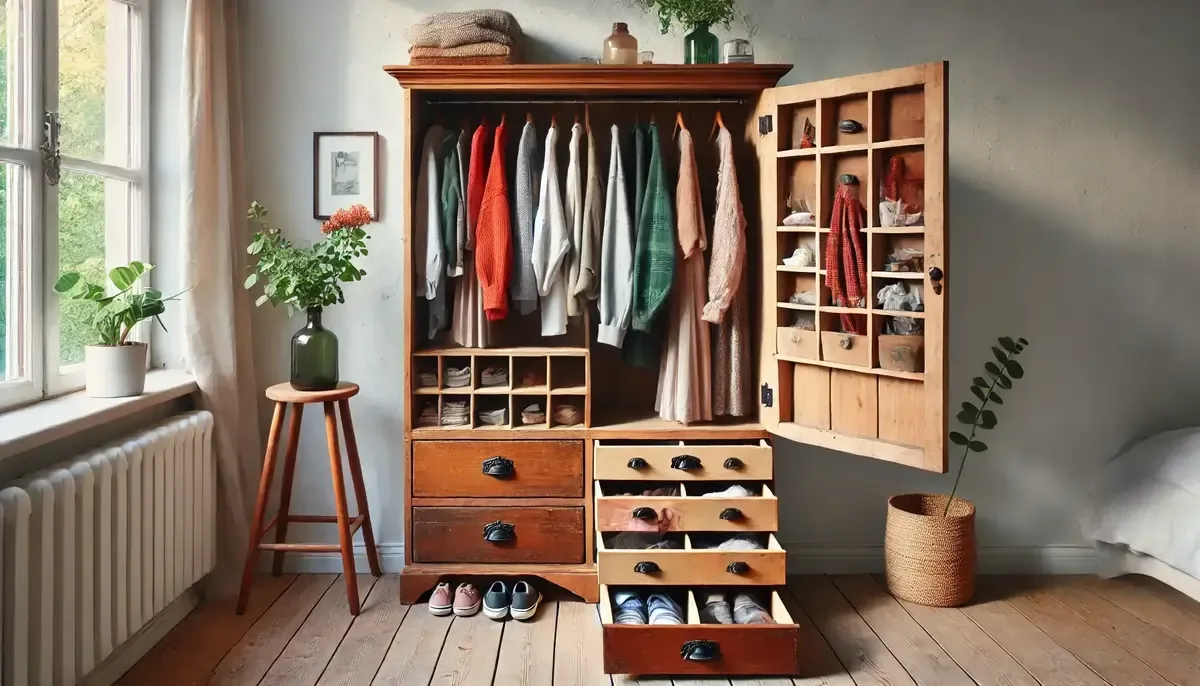
If you have a freestanding wardrobe or an armoire, measure the inside of the carcass the same way.
Hanging space per item: the allowances we use
The spacing buttons are planning allowances. They are deliberately generous, because a rail you can slide a hand into is a rail you will actually use.
| Preset | Rod per item | Suits |
|---|---|---|
| Shirts | 1 inch | Shirts, blouses, light dresses on slim hangers |
| Mixed | 2 inches | A normal mix of shirts, trousers, jackets and dresses |
| Coats | 3 inches | Winter coats, padded jackets, suits on wooden hangers |
Wooden hangers are kinder to shoulders but take more rod than wire, so if your closet is all wood, nudge the number up. Leaving a little air between garments also helps with damp and musty smells, which is covered in why air circulation in a closet matters.
Folded stacks and shelves
Folded clothes are counted in stacks, not pieces, because a stack is what takes up shelf space. A typical folded t-shirt or jumper sits about 4 inches wide once it has settled; thin tops nearer 3 inches, chunky knits closer to 6.
When the closet is 24 inches deep or more, the calculator counts two rows per shelf, one behind the other. That is realistic for things you rotate by season, less so for everyday clothes. If the back row would be forgotten, treat the result as a ceiling and plan on one row.
Knitwear belongs here rather than on the rail. Hanging stretches shoulders out of shape over a few months; the dos and don'ts of hanging sweaters explains the few cases where hanging is fine. Jeans and heavy cotton are happier folded too. For the general question, see folding versus hanging.
Plastic-Free Closet Storage Kit
Store clothes so they last, without plastic boxes.
Free, and you join The Sunday Ring: one useful email a week. Unsubscribe any time.Reading the result and laying out the closet
The layout note underneath the numbers is the practical bit. A few things it will tell you:
- Too shallow to hang. Under about 21 inches, hangers hit the back wall and the door. Give that space to shelves, or hang a rod front-to-back if the closet is narrow and deep.
- Rod longer than the width. A straight rod normally matches the inside width. If the measurement is longer, check whether you have measured a corner closet or added two rods together.
- Two rods. Double hanging, one rod around 40 inches high and one around 80, roughly doubles the short-hang capacity. It only works when the closet is deep enough, and you still need somewhere for dresses and coats.
If the result is lower than the number of things you own, the closet is not the problem. Pick the pieces for this season and put the rest somewhere breathable: a cotton bag, a lidded cardboard box, a suitcase under the bed. How to pack clothes for long-term storage covers folding, cleaning first, and keeping moths out of wool. Sealed plastic tubs are the one thing to avoid for anything natural-fibre, for the reasons in is it safe to store clothes in plastic containers.
No closet, or a very small one
The calculator still works for a rail in the corner of a bedroom. Measure the rail as the rod, the floor space under it as the depth, and count any shelving unit beside it as shelves. The numbers will be modest. That is useful information, not a failure.
Two guides pick up where the tool stops: how to store clothes without a closet for rails, hooks, under-bed boxes and trunks, and closet organisation ideas for small spaces for getting more from a reach-in without rebuilding it.
FAQ
Questions about the closet capacity calculator
How many clothes fit on a closet rod?
As a rule of thumb, one foot of rod holds about 12 shirts on slim hangers, 6 items of a normal mix, or 4 coats and jackets. A standard 48 inch rod in a reach-in closet therefore holds somewhere between 16 and 48 pieces depending on what you hang. Enter your own rod length and spacing to get a figure for your closet.
How deep does a closet need to be for hangers?
About 21 inches is the minimum for a standard hanger to hang straight without touching the back wall or the door. Most built-in closets are 24 inches deep, which leaves a little air around the clothes. If yours is shallower, you can mount a rod front-to-back, use shelves instead, or hang clothes on hooks facing out.
What is the standard height for a closet rod?
A single rod is usually fixed around 66 inches from the floor. For double hanging, the two rods sit at roughly 40 and 80 inches. A long-hang section for dresses and coats needs about 70 inches of clear drop. These are common heights, not rules, so adjust for the people using the closet.
How does the calculator count a second rod?
Ticking Second rod doubles the hanging figure, but only when the closet is at least 21 inches deep. Shallower than that and the lower rod would not be usable, so the tool quietly ignores the tick. Remember that double hanging only suits short items: shirts, folded trousers, jackets, skirts.
Should sweaters be hung or folded?
Folded, for the most part. Knitwear stretches at the shoulders and grows longer when it hangs for months. Put jumpers and cardigans in the folded count and leave the rod for things with structure. If you are short on shelf space, fold them over the bar of a hanger rather than hanging them by the shoulders.
Can I use centimetres instead of inches?
The fields are in inches, so divide your centimetre measurements by 2.54 first. For example, a 120 cm wide closet is about 47 inches, and a 60 cm depth is about 24 inches. The spacing presets work the same way: 1 inch is about 2.5 cm, 2 inches about 5 cm.
Does it work for a wardrobe or armoire rather than a built-in closet?
Yes. Measure the inside of the cabinet rather than the outside. The carcass walls and the door usually take 2 to 3 inches off the external size, and a freestanding wardrobe is often only 20 to 22 inches deep inside, which is tight for hangers. The layout note will flag that if it applies.
My result is lower than the clothes I own. What now?
Treat the number as a ceiling for the space, not a target for your wardrobe. Keep this season's clothes in the closet and store the rest somewhere breathable, such as a cotton bag, a cardboard box or a suitcase. Rotating twice a year keeps the rail usable and makes it much easier to spot moth damage or damp early.